Arrange your flowers beautifully every time
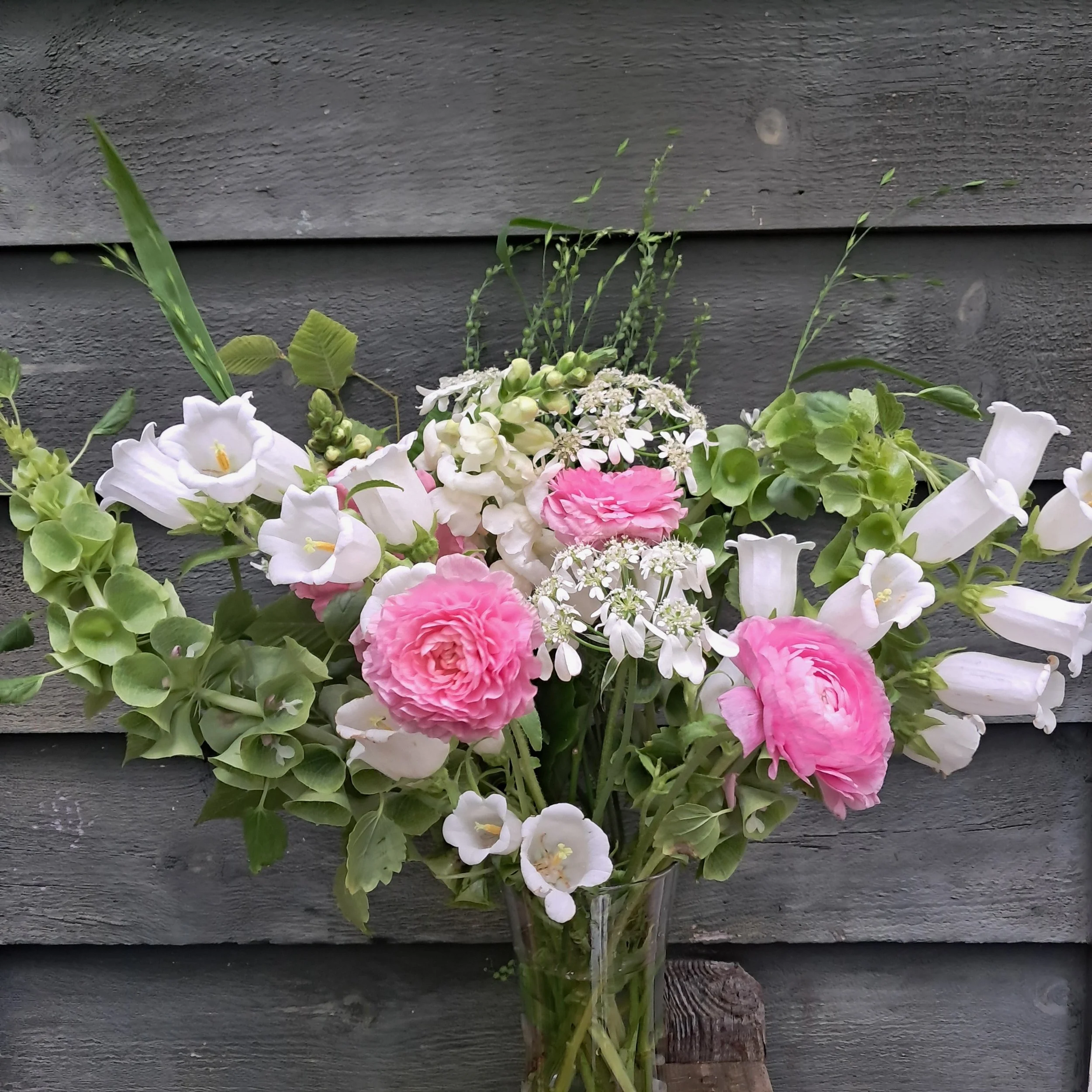
All 6 bouquet ingredients are present in our farm stand bouquets.
Arranging flowers is one of my favorite parts of being a flower farmer. This goes back to when I first started my hand spun yarn business in 2018. The day before every market, I would treat myself to a few stems flower bar at Pine State Flowers to decorate my booth. At some markets, I’d get more compliments on my booth flowers than on my yarn (yikes)! This interest inspired me to take Floret Farm’s famous Flower Arranging Workshop to develop these skills further.
To create beautiful, cohesive arrangements every time, make sure you have each of the following ingredients represented. If you have a market or grocery store bouquet and they are missing some, you can probably supplement by harvesting branches in your yard. All of our farm stand and market bouquets are made with these ingredients in mind.
6 Essential Bouquet Ingredients
Structural Foliage: This is the arrangement’s backbone. It provides structure as well as the eye a rest from all of the visually stimulating components in the rest of the arrangement. Items that work well in this category include Beech, American Hornbeam, and Raspberry branches, but I harvest any woody tree or shrub that I think complements the texture, shape, and colors of my ingredients.
Remember: if harvesting woody stems, be sure to slice up the middle of the branch to increase water uptake.
Supporting Foliage: This foliage provides a bit more visual interest than the structural foliage. Think about interesting foliage like Bells of Ireland, Cerinthe, or Eucalyptus. As you are able, match the shade of the structural foliage.
Textural Ingredient: Here, incorporate items that have berries, pods, bracts, or ripening fruit. Items that work well in this category include: unripe Blueberries and Raspberries and their foliage, Baptisia pods, seed pods or seed heads.
Supporting Ingredients: They are often branching flowers that fill up a bouquet but also complement the focal flowers in terms of texture, shape, and color. These are items like: Cosmos, Ammi, Orlaya, Feverfew, Canterbury Bells.
Focal Flowers: These are generally ‘face’ flowers or open flowers like Sunflowers, Daisies, Dahlias, etc. Focal flowers look best in arrangements when used in odd numbers- 3, 5, etc.
Airy Accents: These are often overlooked, but I think provide the finishing touch on a beautiful arrangement. Airy accents are loose and will move in a breeze, adding a movement and possibly auditory element to the arrangement. We use Cover Oats, Smokebush, River Oats, and decorative grasses in this category.
Arranging tips:
As you are arranging, think about the basic visual elements like color, texture, and shape. How does each element in your bouquet complement another? For example, maybe the center of your Daffodils has a slight green tint that matches your foliage. The eye gets overwhelmed by too many differing elements. As you are able, find elements to unify your bouquet.
Limit your color palette to one shade + foliage (and try to match the foliage shade to the foliage of your flowers)
I’ve noticed that Farmer’s Market Bouquets are often missing foliage and/or have many colors represented. If you notice this in your market bouquets, see how you can split them apart or supplement with items from your own garden.
Sources: Floret Flower Arranging Workshop materials, 2026.